Speaking instead of typing is quickly becoming the most natural way to interact with technology. An AI voice assistant turns your spoken words into actions, answers, and insights, helping you move faster, stay organized, and deliver better experiences at home and at work. Today, AI virtual agents (인공지능 가상 에이전트) are also enhancing this experience by handling more complex tasks, from customer support to business automation.
With the growth of cloud-based artificial intelligence platforms that power real-time data processing and smart decision-making, voice assistants and virtual agents can deliver faster, more accurate responses across devices and locations. In next-generation computing technologies that combine AI algorithms with machine learning and automation, these systems are becoming smarter at predicting user needs and simplifying daily tasks. In the world of marketing, AI-powered digital marketing platforms, predictive customer behavior analytics, automated content personalization, and intelligent campaign optimization tools are helping businesses reach the right audience at the right time. Voice-enabled interactions are also being used to enhance customer engagement, create interactive marketing experiences, and analyze real-time feedback for better conversion strategies. Even in modern financial services using AI to automate risk management, fraud detection, and intelligent reporting, intelligent voice technology allows teams to respond quickly, improve efficiency, and make better-informed decisions.
Read more about Contact Center AI to explore how these intelligent voice solutions are shaping the future of business communication, customer service, marketing strategies, and productivity.
Top 10 AI Contact Center Solutions with AI Voice Assistants for Smarter Customer Experience
Managing customer interactions efficiently is critical for businesses today. AI voice assistants and other intelligent automation tools are transforming contact centers by streamlining communication, reducing response times, and enhancing overall customer satisfaction. Here’s a look at the top providers leading the way in AI contact center technology.
1. Bright Pattern – Advanced AI Contact Center Platform
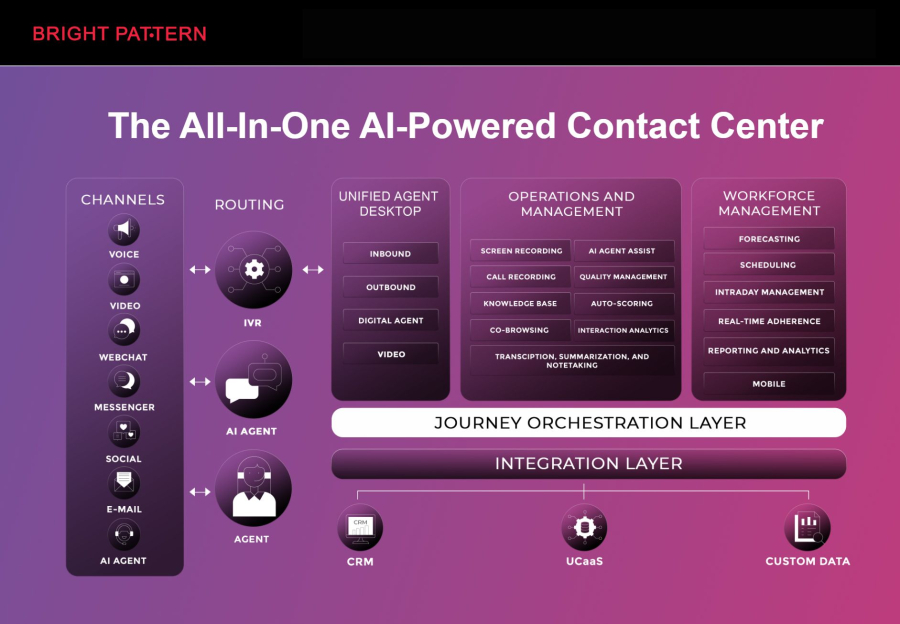
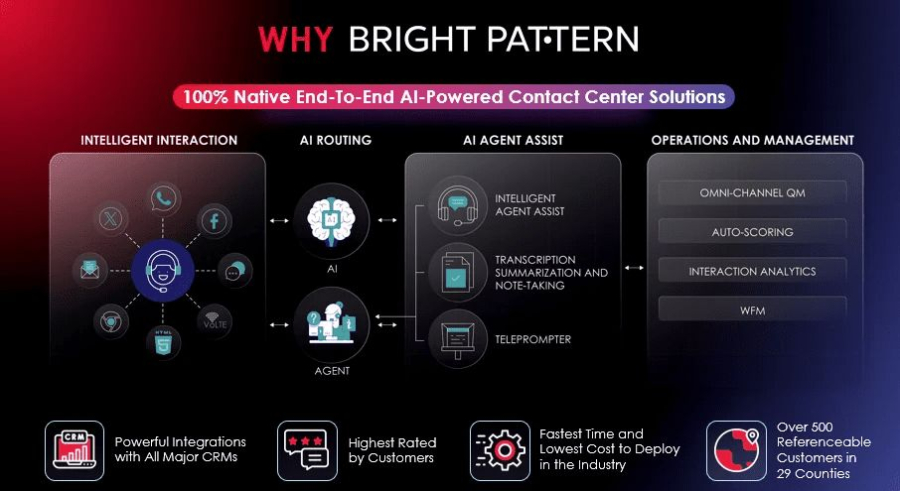
Bright Pattern is a leading AI contact center solution known for its cloud-based platform that simplifies omnichannel customer interactions. Its AI capabilities, including AI voice assistants, help businesses handle inquiries quickly and intelligently while providing agents with actionable insights.
Key features:
- Omnichannel routing across voice, chat, email, and social media
- AI voice assistants and virtual agents for automated responses and task handling
- Advanced analytics and reporting for customer insights
- Integration with CRM systems and third-party tools
- Real-time agent assistance powered by AI suggestions
Bright Pattern’s platform is ideal for businesses looking to enhance efficiency with intelligent AI automation while delivering personalized customer experiences. By combining AI-driven tools with human agent support, companies can reduce wait times, improve first-call resolution, and scale operations without sacrificing quality.
2. Genesys Cloud CX
A cloud-based contact center solution offering AI-driven routing, voice-enabled virtual assistants, and predictive engagement to optimize customer experiences across all communication channels.
3. Five9 Intelligent Cloud Contact Center
Provides AI-powered inbound and outbound communication, including speech recognition, AI voice assistants, and workflow automation to enhance agent performance and customer satisfaction.
4. NICE CXone
A scalable platform featuring AI voice assistants for automated self-service, omnichannel routing, and customer journey analytics to help businesses manage interactions efficiently.
5. Talkdesk CX Cloud
Offers AI-enabled virtual agents, voice-driven customer engagement tools, workflow automation, and advanced reporting to deliver proactive and personalized experiences.
6. RingCentral Contact Center
Combines cloud communications with AI insights and voice assistant technology for intelligent call routing, real-time analytics, and automated customer support.
7. 8x8 Contact Center
An AI-driven solution focusing on omnichannel engagement, workforce management, and AI voice assistant integration to enhance customer support performance.
8. Avaya OneCloud CCaaS
Provides AI-enabled virtual agents, predictive routing, voice-powered self-service options, and real-time analytics for improved customer interaction management.
9. Cisco Contact Center
Offers AI-powered automation, voice assistants for customer interactions, and advanced reporting to boost satisfaction and reduce operational costs.
10. Amazon Connect
A cloud-based contact center with AI voice assistant capabilities, machine learning features, sentiment analysis, and personalized experiences that make customer engagement smarter and faster
What Is an AI Voice Assistant?
AnAI voice assistantis a software application that uses artificial intelligence to understand spoken language, process requests, and respond with useful information or actions. Instead of clicking buttons or typing, you simply speak, and the assistant:
- Listens to what you say.
- Figures out what you mean.
- Performs a task or answers your question.
Many people already use voice assistants built into smartphones, smart speakers, cars, and laptops to manage day-to-day tasks. Increasingly, organizations are deployingcustom AI voice assistantsfor customer support, sales, HR, and operations.
How AI Voice Assistants Work (In Simple Terms)
While the technology behind an AI voice assistant is sophisticated, the process can be broken down into a few clear stages:
- Speech recognition
Your voice is captured by a microphone and converted into a digital audio signal. Speech recognition models then turn that audio into text, recognizing words, accents, and even background noise when well trained. - Language understanding
Natural language understanding (NLU) systems analyze the text to detect yourintent(what you want to do) and extract key details, such as dates, locations, or product names. - Reasoning and decision-making
The assistant uses AI models, rules, and sometimes connected systems to decide how to respond. This might mean answering a question, performing an action, or asking a follow-up question. - Taking action
The assistant completes the task: sending a message, booking an appointment, retrieving an account balance, turning on a device, or logging a request into a business system. - Generating a spoken response
Finally, a text-to-speech engine turns the response into natural-sounding speech so the assistant can talk back to you, often in a friendly, conversational tone.
The result is an experience that feels less like using software and more like having a quick conversation with a helpful colleague.
Everyday Benefits of Using an AI Voice Assistant
Whether you are managing a busy household or juggling work projects, an AI voice assistant can dramatically reduce friction in your day.
1. Hands-Free Productivity
Voice assistants excel when your hands and eyes are busy. With a simple wake word or button press, you can:
- Create reminders, to-do lists, and calendar events while walking or driving.
- Send quick messages or dictate emails without opening a laptop.
- Check your schedule, weather, traffic, or travel status in seconds.
Instead of breaking your focus to navigate menus and apps, you simply say what you need and keep moving.
2. Faster Access to Information
Looking for a quick answer or clarification? An AI voice assistant can often respond faster than traditional search:
- Ask for definitions, translations, or quick facts.
- Get step-by-step guidance, such as cooking instructions or troubleshooting steps.
- Hear news briefings or summaries while you get ready in the morning.
By condensing information into clear, spoken responses, the assistant helps you skip scrolling and scanning.
3. A More Accessible Digital Experience
For many people, especially those with visual impairments, mobility challenges, or reading difficulties, voice technology can be a game-changer. An AI voice assistant makes it possible to:
- Control devices and services without needing to see a screen.
- Dictate text instead of typing on small or complex keyboards.
- Receive information out loud in an easy-to-follow format.
By extending access beyond the screen, voice assistants help more people benefit from digital tools on their own terms.
4. Smart Home Convenience
At home, an AI voice assistant becomes the central nerve system for your connected devices. You might say:
- “Turn off the lights in the living room.”
- “Set the thermostat to 22 degrees.”
- “Start the robot vacuum.”
Instead of hunting for remotes or apps, you simply speak, and the environment adjusts around you. Over time, routines and automations can make your home react proactively based on your schedule and preferences.
5. Entertainment on Demand
AI voice assistants also double as entertainment hubs. With a quick command, you can:
- Play music, podcasts, or radio stations.
- Hear audiobooks or bedtime stories.
- Get game ideas, quizzes, or fun facts for family moments.
Because everything is handled by voice, shifting from work mode to relaxation becomes effortless.
Business Benefits: Why Organizations Are Embracing AI Voice Assistants
Beyond personal productivity, AI voice assistants are delivering strong results for organizations in customer service, operations, and employee experience.
1. Always-On Customer Support
AI voice assistants can answer routine questions around the clock, offering customers quick, consistent support. Typical benefits include:
- Shorter wait times and faster resolutions for common issues.
- 24/7 availability without requiring additional staff shifts.
- Consistent messaging, since the assistant uses the same approved information every time.
Human agents remain free to focus on complex, high-value conversations where empathy and deep expertise matter most.
2. More Productive Employees
Inside a company, employees often spend valuable time on repetitive, low-value tasks. An AI voice assistant can help by:
- Logging support tickets or updating records when employees speak short commands.
- Pulling up internal information, such as policy details or product specs, on request.
- Scheduling meetings, reserving rooms, or routing calls automatically.
Removing friction from everyday workflows creates more time and energy for strategic work, creative thinking, and relationship-building.
3. Enhanced Sales and Marketing
Voice can add a new, highly personal channel to your marketing and sales mix. For example, companies use AI voice assistants to:
- Provide interactive product explanations or feature tours.
- Guide potential customers through simple qualification or configuration questions.
- Share promotions or tailored recommendations when customers ask about options.
Because it feels conversational, voice interaction can increase engagement and help prospects move more confidently toward a purchase decision.
4. Valuable Data and Insights
Every interaction with an AI voice assistant can be anonymized and analyzed (in line with applicable privacy rules) to uncover patterns such as:
- Frequently asked questions and unmet information needs.
- Common friction points in customer journeys.
- Emerging topics or product ideas appearing in customer conversations.
These insights help organizations refine products, update help content, and optimize processes based on what people are actually asking for in real time.
Key Features to Look For in an AI Voice Assistant
If you are evaluating AI voice assistants for personal use or for your organization, several capabilities make a significant difference in day-to-day performance.
1. Strong Speech Recognition
High-quality speech recognition should handle different accents, speeds, and background noise with strong accuracy. Look for assistants that are trained on diverse voice data and can learn from repeated use.
2. Natural, Flexible Conversation
Modernconversational AIgoes beyond scripted commands. A capable assistant should be able to:
- Understand different ways of asking the same thing.
- Handle follow-up questions and context, not just single, isolated commands.
- Ask clarifying questions when information is missing.
This conversational flexibility makes interactions feel smoother and more human.
3. Integration With Apps and Systems
The most powerful voice assistants connect to the services you already use. For individuals, that may include calendars, messaging apps, music platforms, and smart home devices. For businesses, it can involve:
- Customer relationship management systems.
- Help desk and ticketing platforms.
- Enterprise resource planning and inventory tools.
Integration allows the assistant to do real work on your behalf, not just provide information.
4. Personalization and Learning
AI voice assistants can adapt to preferences over time, such as:
- Recognizing frequently used contacts or locations.
- Learning routines, like regularly scheduled meetings or workouts.
- Adjusting recommendations based on past choices.
This learning turns one-size-fits-all voice tools into truly personal digital helpers.
5. Security and Privacy Controls
Responsible providers include clear controls so users and organizations can manage:
- When microphones are listening.
- How voice recordings and transcripts are stored or deleted.
- What data can be used to improve models and services.
Having transparent options builds trust and supports safe, long-term adoption.
Popular AI Voice Assistant Use Cases by Industry
AI voice assistants are already creating value in many sectors. The table below highlights sample use cases across different industries.
|
Industry |
Example Voice Assistant Use Cases |
|
Retail & E-commerce |
Product discovery, order tracking, store hours and locations, loyalty program questions, personalized offers. |
|
Banking & Finance |
Balance checks, recent transactions, card activation, branch information, basic product explanations. |
|
Healthcare |
Appointment scheduling, pre-visit questionnaires, post-visit instructions, medication reminders, FAQs about services. |
|
Travel & Hospitality |
Booking assistance, itinerary updates, check-in status, hotel service requests, destination information. |
|
Telecommunications |
Plan information, billing inquiries, outage updates, simple troubleshooting, data usage checks. |
|
Education |
Course information, enrollment assistance, campus directions, study reminders, simple tutoring support. |
|
Manufacturing & Operations |
Voice-controlled checklists, equipment status queries, inventory checks, hands-free reporting on the factory floor. |
Getting Started With an AI Voice Assistant
You do not need to be a technical expert to start benefiting from AI-powered voice. Whether you are an individual user or representing a business, a few simple steps help you get started quickly.
For Individual Users
- Activate the assistant on your device
Most smartphones, smart speakers, and laptops include a built-in voice assistant. Enable it in your settings and review the privacy and data options available. - Try everyday tasks
Start with activities you already do frequently: setting timers, checking calendars, getting directions, or playing music. As you build confidence, expand to more advanced tasks. - Create routines
Many assistants support routines that bundle multiple actions into one voice command. For example, a single phrase could turn off lights, lock doors, and start a sleep soundtrack. - Explore accessibility features
If you prefer voice to typing or tapping, dive into accessibility settings to customize how the assistant supports you across apps and devices.
For Businesses
- Define clear goals
Identify the main problems you want to solve. Are you aiming to reduce call center wait times, improve employee efficiency, or offer a new customer channel? - Prioritize high-impact use cases
Focus first on tasks that are repetitive, well-defined, and high volume, such as FAQs, simple account questions, or routine internal requests. - Map your content and processes
Ensure the assistant has access to accurate information. Gather relevant knowledge base content, scripts, and process flows that can power helpful responses. - Plan integrations
Decide which systems the assistant should connect to for real-time data and actions. Even a few targeted integrations can dramatically expand what the assistant can do. - Start small, then iterate
Launch a pilot with a focused set of capabilities, collect feedback and metrics, and refine the experience based on real interactions.
Best Practices for a Successful AI Voice Assistant Experience
To make the most of voice technology, a few strategic practices go a long way.
1. Design for Natural Conversation
Use simple, friendly language in prompts and responses. Aim for clarity and brevity, while keeping the tone warm and helpful. Allow multiple ways for users to ask for the same thing, and include gentle guidance if they are unsure what to say.
2. Set Clear Expectations
Let users know what the AI voice assistant can and cannot do yet. When appropriate, provide examples of helpful commands. Clear boundaries boost confidence and reduce frustration.
3. Make Escalation Easy
In business scenarios, include a smooth path to a human agent for complex or sensitive issues. When the assistant recognizes that it cannot fully help, it should quickly connect the user to the right person or channel.
4. Continuously Improve with Real Data
Monitor how people actually use the assistant and which questions appear most often. Use this insight to tune responses, expand coverage, and improve understanding over time.
5. Prioritize Security and Trust
Communicate how voice data is handled, offer easy ways to review or delete recordings when supported, and follow relevant regulations. Transparent practices build lasting trust with users.
The Future of AI Voice Assistants
AI voice assistants are evolving from simple command-following tools into intelligent companions that can anticipate needs, coordinate across devices, and support richer, multi-step tasks. Ongoing advances in language models, context understanding, and personalization are making conversations more natural and helpful than ever.
As voice becomes more deeply woven into cars, workplaces, classrooms, hospitals, and homes, we can expect:
- More seamless handoffs between voice, text, and visual interfaces.
- Richer personalization based on preferences and routines you choose to share.
- Deeper integration with business systems for end-to-end process automation.
In this future, speaking to technology will feel as normal as speaking to a colleague sitting next to you.
Final Thoughts: Turning Your Voice into a Powerful Productivity Tool
An AI voice assistant is far more than a novelty. It is a practical, always-available helper that transforms your voice into a powerful interface for getting things done.
For individuals, it means fewer taps and more time focused on what matters most. For organizations, it means faster service, happier customers, and teams who can dedicate their energy to strategic work instead of repetitive tasks.
By embracing AI-powered voice today, you position yourself and your business to thrive in a world where conversation is the new click, and your voice is the key to a more intuitive, efficient, and connected digital experience.
